Tuesday, January 30, 2007

Jesus and the Pharisees III

(Heard on NPR January 25th)

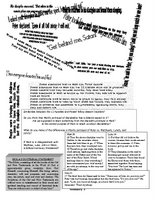
“On the opposite side of every divide in American life there stands the other. Depending on who you are the other might be a right wing evangelical or a left wing Jew. Or the other might be a group of Muslims praying in an airport, two gays kissing on the subway, or a gen next 20 something with purple spiked hair and a nose ring.” -Juan Williams, author of eyes on the prize: America’s Civil Rights Years, 1954-1965

Who is the other to you?

Mark 2:13-17

…He got up, took his mat and walked out in full view of them all. This amazed everyone and they praised God, saying, "We have never seen anything like this!"

13 Once again Jesus went out beside the lake. A large crowd came to him, and he began to teach them. 14 As he walked along, he saw Levi son of Alphaeus sitting at the tax collector's booth. "Follow me," Jesus told him, and Levi got up and followed him.

15 While Jesus was having dinner at Levi's house, many tax collectors and "sinners" were eating with him and his disciples, for there were many who followed him. 16 When the teachers of the law who were Pharisees saw him eating with the "sinners" and tax collectors, they asked his disciples: "Why does he eat with tax collectors and `sinners'?"

17 On hearing this, Jesus said to them, "It is not the healthy who need a doctor, but the sick. I have not come to call the righteous, but sinners."


Has somebody ever tried to push their conviction on you? Why do you think they tried?

Have you ever tried to push your convictions on others? Why did you try?


The Pharisees pursued a program to extend the imperatives of the symbolic order to the masses while themselves following a rigorous practice of purity.

In today’s episode and the next two, we see Jesus directly confront the central tenets of the Pharisaic holiness code:

1) Their rules of table fellowship

2) Public Piety

3) Maintenance of the Sabbath

Table Fellowship

Table Fellowship was the central expression of social intercourse in antiquity:

For the oriental every table fellowship is a guarantee of peace, trust, or brotherhood…The oriental, to whom symbolic action means more than it does to us, would immediately understand the acceptance of the outcasts into table fellowship with Jesus as an offer of salvation to guilty sinners and as the assurance of forgiveness. Hence the objections of the Pharisees…who held that the pious souls only have table fellowship with the righteous.

–Joachim Jeremias, The Eucharistic Words of Jesus

What are some ways that we guarantee peace, trust, and brother(sister)hood today?

Do we even have anything that resembles this?


If you haven't already done so (Ian) watch Dr. Muffins

What is the correct question to ask:

1) Is sin contagious?

2) Are we well?

Which of the two statements do you agree with more?

1) By grace, we are saints who sin.

2) We are Sinners saved by grace.


Tuesday, January 16, 2007

Jesus and the Pharisees II

Do you see anything in this text that is subversive to the religious leaders?:

A man with leprosy came to him and begged him on his knees, "If you are willing, you can make me clean."

Filled with compassion, Jesus reached out his hand and touched the man. "I am willing," he said. "Be clean!" Immediately the leprosy left him and he was cured.

Jesus sent him away at once with a strong warning: "See that you don't tell this to anyone. But go, show yourself to the priest and offer the sacrifices that Moses commanded for your cleansing, as a testimony to them." Instead he went out and began to talk freely, spreading the news. As a result, Jesus could no longer enter a town openly but stayed outside in lonely places. Yet the people still came to him from everywhere.

----------------------------------------

2:1 A few days later, when Jesus again entered Capernaum, the people heard that he had come home. So many gathered that there was no room left, not even outside the door, and he preached the word to them. Some men came, bringing to him a paralytic, carried by four of them. Since they could not get him to Jesus because of the crowd, they made an opening in the roof above Jesus and, after digging through it, lowered the mat the paralyzed man was lying on. When Jesus saw their faith, he said to the paralytic, "Son, your sins are forgiven."

Now some teachers of the law were sitting there, thinking to themselves, "Why does this fellow talk like that? He's blaspheming! Who can forgive sins but God alone?"

Immediately Jesus knew in his spirit that this was what they were thinking in their hearts, and he said to them, "Why are you thinking these things? Which is easier: to say to the paralytic, `Your sins are forgiven,' or to say, `Get up, take your mat and walk'? But that you may know that the Son of Man has authority on earth to forgive sins . . . ." He said to the paralytic, "I tell you, get up, take your mat and go home." He got up, took his mat and walked out in full view of them all. This amazed everyone and they praised God, saying, "We have never seen anything like this!"

-----------------

Who can forgive sins but God alone?

What are the Pharisees really saying?

Who was responsible in Israel for pronouncements of forgiveness?

Who is Jesus threatening?

the Son of Man has authority on earth to forgive sins

What is Jesus saying?

2 Options:

1) Jesus can forgive sins

2) Humans (sons of Adam) can forgive sins

Which is easier: to say to the paralytic, `Your sins are forgiven,' or to say, `Get up, take your mat and walk'?

Would you rather:

Have social Standing in a community

or

Be able to Physically stand on your own two feet?

“A man with leprosy came to him and begged him on his knees,”

“Some men came, bringing to him a paralytic, carried by four of them.”

How would Jesus’ ministry have looked differently if he focused his healing ministry on the wealthy and political leaders?

“This amazed everyone and they praised God, saying, "We have never seen anything like this!"

Have you ever had your religious actions, cause others to glorify God?

Have you ever had any of your actions, cause others to glorify God?


Wednesday, January 10, 2007

Jesus and the Pharisees I

Mark 1:21-28

21 They went to Capernaum, and when the Sabbath came, Jesus went into the synagogue and began to teach. 22 The people were amazed at his teaching, because he taught them as one who had authority, not as the teachers of the law. 23 Just then a man in their synagogue who was possessed by an evil spirit cried out, 24 "What do you want with us, Jesus of Nazareth? Have you come to destroy us? I know who you are-the Holy One of God!"

25 "Be quiet!" said Jesus sternly. "Come out of him!" 26 The evil spirit shook the man violently and came out of him with a shriek.

27 The people were all so amazed that they asked each other, "What is this? A new teaching-and with authority! He even gives orders to evil spirits and they obey him." 28 News about him spread quickly over the whole region of Galilee.

Mark’s plotting of the Scribes and Pharisees

Jesus’ first public act: Exorcism of an “unclean spirit,” as “teaching with authority,” in contrast with the scribes. (1:21)

Forgiving paralytic’s sins (2:1-12)

Eating with tax collectors and sinners (2:13-17)

Disciples not fasting (2:18-20)

Disciples eating grain on the Sabbath (2:23-28)

Jesus Healed on the Sabbath (3:1-6)

Casting out demons (3:13-30)

Not only does Jesus carry out his mission in contrast and opposition to the scribes and Pharisees, but they actively oppose him at every turn and seek to destroy him from the time of his initial campaign in Galilee.

Pharisees absent from the narrative while Jesus performs Moses and Elijah-like acts, (sea crossing, exorcism, healings, and wilderness feeding)

7:1 The Pharisees and some of the teachers of the law who had come from Jerusalem gathered around Jesus

Then the Pharisees come from Jerusalem and attack the disciples for not washing their hands. (7:2-13)

The Pharisees request that Jesus provide them with a sign (8:11)

Pharisees ask Jesus about divorce (10:2-12)

Jesus goes to Jerusalem

11:11 Jesus entered Jerusalem and went to the temple.

Pharisees come to entrap Jesus about paying money to Caesar (12:13-17)

Quiz about marriage in heaven (12:18-27)

Quiz about greatest commandment (12:28-34)

Looked for a way to kill Jesus (14:1)

Come to arrest him (14:43)


Who were the Pharisees?

Pharisees appear to have comprised a political faction among the broader range of scribes functioning in connection with the temple-state. The fragments of information available indicate that they were active in connection with the Jerusalem Temple government and that they served as representatives of the high-priestly rulers in dealing with villages and outlying districts such as Galilee. They were known especially as “accurate interpreters” of the Law and as having promulgated additional rulings, “the traditions of the elders,” that held the authority of state law at points under the Hasmoneans. Their legal rulings and opinions in later rabbinic literature are concentrated on issues such as eating and tithing of agricultural produce.


Wednesday, November 08, 2006

Missing Bulletins 9/24 -11/05

I try to post bulletins from every week's gathering, but have been lagging lately. Here's the last 5 that I missed:

Questions:
1. If I were to begin today's service with the announcement "The Kingdom of God is here!" How would you respond?
2. Are you excited about being the member of a kingdom that started with executions?
3. Is the Kingdom of God more present or less present than 2000 years ago? 100 years?


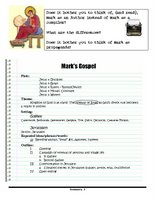
Does it bother you to think of, (and read), Mark as an Author instead of Mark as a compiler? What are the differences? Does it bother you to think of Mark as propaganda?


Do you think that Mark’s portrayal of discipleship has a didactic aspect to it? Are we supposed to learn something from the disciple’s portrayal in Mark? Is the central purpose of Mark to teach us about discipleship? What do you make of the differences in Mark’s portrayal of Peter vs. Matthew’s, Luke’s, and John’s? If Mark is in disagreement with Matthew, Luke, John or Peter,is Biblical inerrancy threatened?


What do you usually hear emphasized in this story?
What are the similarities of these two healings? What do you see repeated?
Why are some more comfortable with impurity than allusions to Israel?
If both women are representatives of Israel undergoing renewal, what do/can they teach us?
Why women?


1. If Mark is not teaching about discipleship, and if we read the verse in context, why did Mark include this episode in his story?
a. Is Jesus saying something to the Scribes?
2. Why is the widow poor?
3. Why are the widows and the orphans so important to God?
4. What relevance does the widow have for us today?


ALL HANDOUTS ARE PRINTABLE PDFs, meaning that they will actually be legible when you click on them, and you can even print them out without distortion. If you do not have adobe page reader, (you have no excuse not to, unless you use a mac), you can get it here.

Tuesday, November 07, 2006

"If an outsider fights an angel, he may find himself fighting all angels."


I watched a documentary on the history channel the other day on the Hells Angels, and was struck by the strong sense of brotherhood that they demonstrate(d).
Early on in the Hells Angels' history a member of their motorcycle club was arrested. The man didn't personally have money to hire an attorney, nor did the club that he was a representative of. So, in order to cover legal fees, members of the Hells Angels gathered together sold some illegal substances, and then used the money to help their "brother" out.
I watched the documentary and was impressed with the promise that one member has to another to defend and to help one another. I began to feel embarrassed by the global church's inability to achieve the same level of devotion to one another. Members of the Church, should respond to one another with at least an equal amount of consideration towards one another that an "outlaw motorcycle club" has. But instead we neglect people's needs within our own church communities, we gossip about one another, turn a blind eye towards other's afflictions, and just generally operate autonomously, separating ourselves from one another's problems.

May our devotion to one another grow. May we be able to commend brother/sisterhood, and may our concern and action for one another be seen as a model for others.

Monday, November 06, 2006

LemonBookPro


I got an e-mail today announcing that my replacement computer had shipped. After sending my MacBookPro in for a new logic board, twice, a new power adapter, and two new batteries, my laptop still failed to charge or recognize that there was a new battery installed. There was also a bizarre hum that my computer emitted anytime the screen dimmed, (this began to occur after the logic boards were replaced to solve the high pitch ringing noise). Applecare offered to install a third logic board to solve this problem, but I declined, requesting instead a new or refurbished machine. Much to my surprise, I was offered the new updated MacBookPro, (I had already been complaining that my machine was now out of date), with the new intel core 2 duo processor, twice as much ram, and more memory. Hopefully this means that we will get to see more movie projects at Community soon. It's pretty amazing when having a lemon seems beneficial. Now if Wednesday would only hurry up and arrive...

Saturday, October 28, 2006

Just as I am


I was thinking about how some of us are pretty good at recognizing that God accepts us just as we are. We apologize to God for falling short at times, and take his patience for granted as we work to become the disciples that he calls us to, (even though if at times we seem to take one step forward and two steps back). But we sometimes have a hard time extending this mindset to others around us.


Maybe we could amend the popular hymn Just As I Am, with a stanza entitled Just As You Are.

Just as I am, without one plea,
But that Thy blood was shed for me,
And that Thou bidst me come to Thee,
O Lamb of God, I come, I come.

Just as You are, I accept you,
That God, the same does for you too,
And when though bidst me come to thee,
I hope with God, I'll come, I'll come.

Super cheesy, I know, but I think about the 100s of thousands of people who came forward to this hymn during altar calls all around America, and can't help but hope that if they had heard the plea to love others as Jesus loved us, accepting them as they are, that maybe our churches would look different.

Just a thought...and a redundant one at that.